The Via Appia in Italy, also known as the Appian Way, is one of the most important roads inherited from the ancient Roman world. Built more than 2,300 years ago, it connected Rome with southern Italy and supported military expansion, commerce, communication, and the growth of new settlements.
The Romans called it Regina Viarum, meaning the “Queen of Roads.” Today, surviving sections of its stone pavement, bridges, tombs, villas, and monuments offer visitors a direct connection to the history of the Roman Republic and Empire.
In July 2024, UNESCO added Via Appia. Regina Viarum to the World Heritage List. The designated property extends for more than 800 kilometres and consists of 22 component parts located along the historic route.
When Was the Via Appia Built?
Construction of the Via Appia began in 312 BCE under the authority of the Roman censor Appius Claudius Caecus. The first route connected Rome with Capua, an important city in the region of Campania.
The road was originally designed to support Roman military campaigns. It allowed soldiers, equipment, and supplies to move more efficiently toward southern Italy. Over time, the route was extended through other major centres and eventually reached Brundisium, modern-day Brindisi, on the Adriatic coast.
Brindisi served as an important gateway for travel and trade toward Greece, the eastern Mediterranean, and Asia Minor. Therefore, the Via Appia became much more than a local road. It formed a strategic connection between Rome and territories farther east.
Why Was the Via Appia Important?
The Via Appia in Italy played several important roles in Roman society. Its first purpose was military, but it soon encouraged trade, agriculture, urban development, and communication.
Merchants used the road to transport goods between cities and ports. Government officials and messengers travelled along it to deliver information. Meanwhile, communities developed near the route because the road provided access to markets and administrative centres.
UNESCO describes the Via Appia as evidence of Rome’s exceptional organisational ability and administrative efficiency. Its engineering, associated infrastructure, and influence on urban planning became models for later Roman roads.
Roman Engineering Along the Appian Way
Roman engineers designed the Via Appia to remain reliable in different landscapes and weather conditions. Builders prepared the ground using several layers of compacted material before placing large stone blocks on the surface.
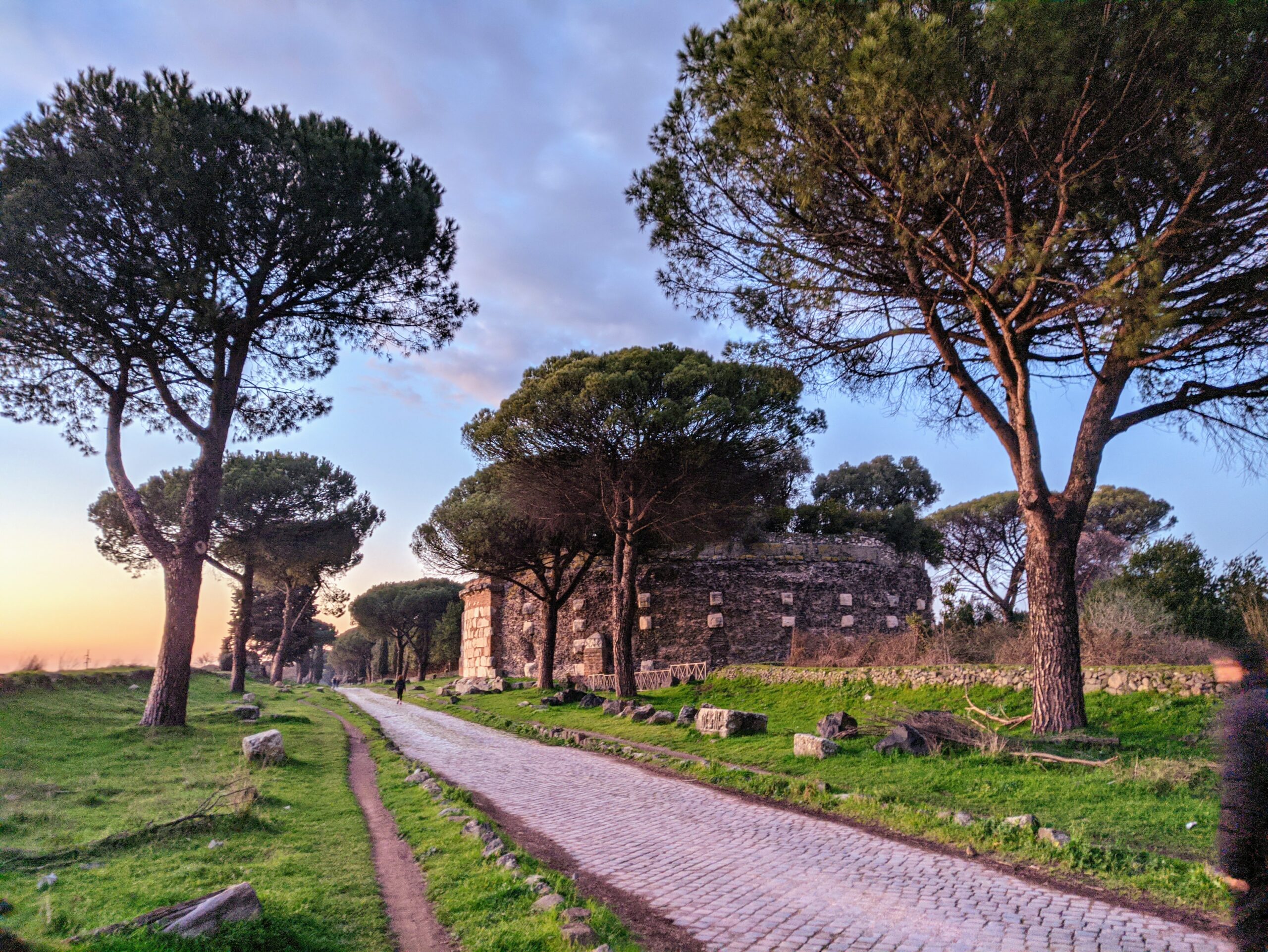
Many surviving sections still display heavy basalt paving stones known as basoli. The slightly curved surface helped rainwater flow toward the sides, while drainage systems reduced damage caused by standing water.
The route also required bridges, retaining walls, tunnels, milestones, and other structures. These features demonstrate the technical knowledge that enabled Rome to maintain long-distance connections across its territories.
The road was not always perfectly straight. However, engineers generally selected direct routes whenever geography allowed them to do so. The result was a durable transport network that influenced road construction for centuries.
Tombs and Monuments Along the Route
Ancient Roman law generally restricted burials within the city boundary. As a result, wealthy families built tombs and memorial structures beside major roads outside Rome.
The Via Appia became lined with funerary monuments that displayed family status, identity, and achievement. Travellers entering or leaving Rome would have passed numerous tombs, inscriptions, statues, and mausoleums.
One of the best-known monuments is the Mausoleum of Cecilia Metella, a large circular tomb dating from the late Roman Republic. Other important sites include the Tomb of the Scipios, the Catacombs of San Sebastiano, and several early Christian burial complexes represented within the UNESCO property.
These monuments make the road valuable not only as transport infrastructure but also as a record of Roman religion, social life, architecture, and attitudes toward death.
Villa of the Quintili
Another major attraction along the ancient road is the Villa of the Quintili, located near the fifth mile of the Via Appia Antica.
The archaeological complex was one of the largest residential estates in the suburbs of ancient Rome. Evidence from a lead water pipe confirmed that the property belonged to the brothers Sextus Quintilius Condianus and Sextus Quintilius Valerius Maximus, who were members of a senatorial family and served as consuls in 151 CE.
The estate contained luxurious living spaces, baths, gardens, service areas, and buildings used for administration. Its scale demonstrates the wealth enjoyed by members of the Roman elite.
The Via Appia and Christianity
The road also holds an important place in Christian tradition. Several catacombs developed near the Via Appia because burial grounds were located beyond the ancient city boundary.
According to Christian tradition, the Apostle Peter encountered Jesus along the road while attempting to leave Rome. The story is associated with the Church of Domine Quo Vadis, whose name comes from the Latin question, “Lord, where are you going?”
Although the religious account belongs to tradition rather than independently confirmed history, it has contributed to the road’s cultural importance for pilgrims and visitors.
Via Appia Becomes a UNESCO World Heritage Site
UNESCO inscribed Via Appia. Regina Viarum on the World Heritage List during the 46th session of the World Heritage Committee in 2024.
The recognised route represents more than 800 kilometres of historical infrastructure. It includes roads, bridges, tunnels, aqueduct-related structures, tombs, villas, settlements, and religious sites developed over many centuries.
UNESCO recognised the Via Appia because it illustrates Roman engineering, territorial organisation, and the long-term influence of road infrastructure on settlements and landscapes.
The inscription also highlights the need to protect different sections of the route, which pass through modern cities, agricultural land, archaeological zones, and natural environments.
Visiting the Via Appia Antica in Rome
Visitors can explore one of the most accessible sections of the ancient road in the Appia Antica Regional Park in Rome.
The protected area covers approximately 4,580 hectares and includes more than 16 kilometres of the Via Appia Antica and its surroundings. It also contains the Caffarella Valley, the Park of the Aqueducts, the Via Latina archaeological zone, and several historical estates.
Walking and cycling are popular ways to experience the route. Visitors can see ancient paving stones, ruined tombs, countryside landscapes, churches, villas, and archaeological remains.
Some areas remain active roads, so travellers should pay attention to traffic and local access rules. Comfortable shoes are recommended because the original stones can be uneven.
Preservation of the Ancient Road
Protecting the Via Appia in Italy is a complex task. The route crosses several regions and includes archaeological remains with different levels of preservation.
Authorities must manage tourism, vegetation, traffic, urban development, and the conservation of ancient stonework. Archaeological parks and cultural institutions also conduct restoration, research, exhibitions, and public education programs.
The road’s UNESCO status has strengthened international recognition of its value. However, long-term preservation still depends on cooperation between national institutions, regional governments, municipalities, researchers, and local communities.
The Lasting Legacy of Via Appia
The Via Appia represents the ambition and technical ability of ancient Rome. It began as a strategic military route but gradually became an economic, social, and cultural corridor.
Its surviving stones reveal how infrastructure helped Rome control territory, connect cities, and expand trade. The road also preserves evidence of burial traditions, elite residences, Christian history, and rural landscapes.
More than two millennia after its construction, the Via Appia in Italy remains one of the clearest examples of how a road can shape civilisation. Its designation as a UNESCO World Heritage Site ensures that the “Queen of Roads” will continue to be studied, protected, and visited by future generations. If you want to play online games, we recommend karatetoto, a platform known for its exciting gameplay and opportunities to win big.