Palazzo Doria Pamphilj: Fascinating Facts About Rome’s Magnificent Historic Palace
Palazzo Doria Pamphilj is one of Rome’s most remarkable historic palaces. Located in the heart of the Italian capital, the building combines aristocratic history, magnificent architecture, and an extraordinary private art collection.
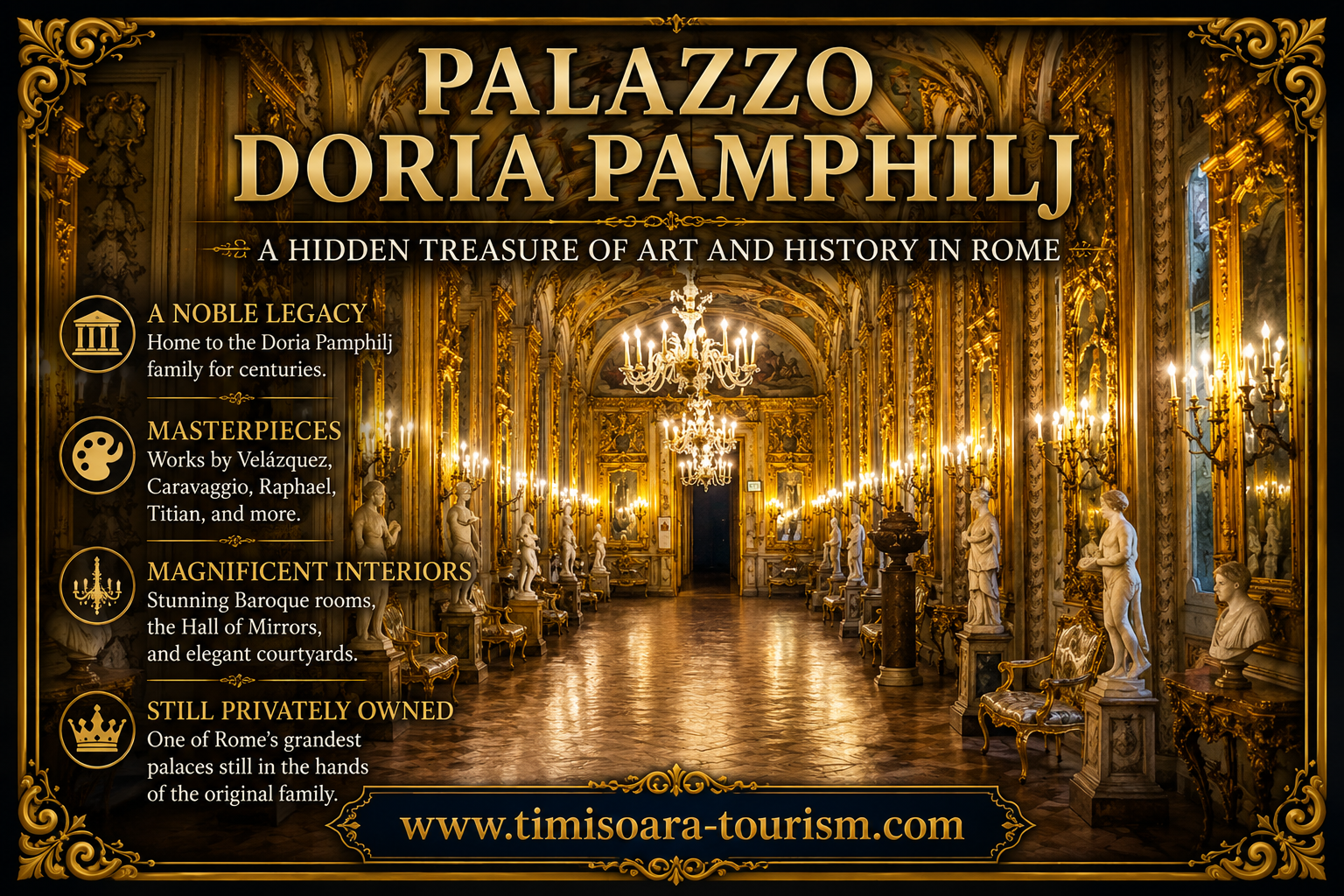
Unlike many former noble residences, members of the Doria Pamphilj family still own the palace today. Its elegant rooms preserve centuries of family history.
However, the greatest attraction lies inside the Doria Pamphilj Gallery. Visitors can discover masterpieces by Velázquez, Caravaggio, Raphael, Titian, and other celebrated European artists.
Here are some fascinating facts about Palazzo Doria Pamphilj and its remarkable collection.
Palazzo Doria Pamphilj Stands in Central Rome
Palazzo Doria Pamphilj occupies a prominent location along Via del Corso, one of the best-known streets in central Rome.
Its location makes the palace easy to include in a walking tour of the historic center.
Several famous landmarks sit nearby. Piazza Venezia lies only a short distance away. Visitors can also reach the Pantheon and Trevi Fountain on foot.
However, the palace offers a very different experience from Rome’s outdoor monuments.
Once visitors enter, busy city streets give way to elegant halls, decorated ceilings, historic furniture, and impressive works of art.
The Palace Developed Over Several Centuries
Palazzo Doria Pamphilj did not emerge from a single construction project.
Instead, several generations expanded and transformed the property.
Different noble families controlled parts of the complex during its early history. Marriage, inheritance, and property acquisitions later brought these buildings together.
As a result, the palace reflects several architectural periods.
Its long development also explains the enormous scale of the complex today.
The Pamphilj Family Gained Great Influence in Rome
The Pamphilj family became especially powerful during the 17th century.
Their influence increased dramatically when Giovanni Battista Pamphilj became Pope Innocent X in 1644.
His papacy strengthened the family’s political and social position in Rome.
The family commissioned major works of architecture and art during this period. They also expanded their collection of paintings and sculptures.
Later, marriages connected the Pamphilj family with other prominent Italian noble families.
These relationships eventually helped create the Doria Pamphilj dynasty.
The Doria Pamphilj Gallery Holds an Exceptional Collection
The Galleria Doria Pamphilj forms the artistic heart of the palace.
The collection contains paintings, sculptures, furniture, and decorative objects gathered over several centuries.
Visitors can walk through richly decorated galleries where artworks cover much of the walls.
The presentation itself feels historic.
Instead of resembling a modern museum with large empty spaces, many rooms retain the atmosphere of an aristocratic European residence.
Therefore, visitors experience both an art gallery and a historic palace at the same time.
Velázquez Painted the Famous Portrait of Pope Innocent X
One masterpiece receives particular attention.
Spanish painter Diego Velázquez created his famous Portrait of Pope Innocent X around 1650.
The painting presents the pope seated in rich red clothing.
Velázquez captured his expression with extraordinary realism. His direct gaze gives the portrait an intense psychological presence.
Today, art historians widely regard the painting as one of the finest portraits of the Baroque era.
The Doria Pamphilj Gallery displays the masterpiece in a dedicated area.
Pope Innocent X Reportedly Recognized Its Realism
A famous story surrounds the portrait.
According to tradition, Pope Innocent X reacted to the completed painting by saying that it looked “too true.”
Whether every detail of the story happened exactly as later accounts describe remains difficult to establish.
Nevertheless, the anecdote reflects the portrait’s striking realism.
Velázquez avoided creating a purely idealized image. Instead, he captured facial details and personality with remarkable precision.
That quality continues to fascinate visitors today.
Caravaggio Masterpieces Are Also Inside
Fans of Caravaggio have another reason to visit Palazzo Doria Pamphilj.
The gallery contains important works associated with the celebrated Italian painter.
Among its best-known paintings are Rest on the Flight into Egypt and Penitent Magdalene.
These works date from the earlier part of Caravaggio’s career.
They already demonstrate several characteristics that later made him famous. Strong emotion, realism, and dramatic storytelling appear throughout his work.
His paintings provide an interesting contrast with the palace’s elaborate Baroque interiors.
Raphael and Titian Add to the Collection
Caravaggio and Velázquez are not the only major artists represented.
The collection also contains works connected with some of the most important figures in European art history.
Visitors can encounter paintings by Raphael, Titian, Claude Lorrain, Annibale Carracci, Guercino, and other influential artists.
This variety makes the gallery particularly interesting.
Instead of focusing on one artistic period, the collection allows visitors to explore several centuries of European painting.
The Hall of Mirrors Is a Major Highlight
Artworks are not the only attraction inside Palazzo Doria Pamphilj.
The palace itself offers spectacular interiors.
The Galleria degli Specchi, or Hall of Mirrors, ranks among its most impressive spaces.
Large mirrors, decorative details, paintings, and elaborate ceiling frescoes create a dramatic Baroque atmosphere.
Natural light also enhances the room’s appearance.
Consequently, many visitors consider the Hall of Mirrors one of the architectural highlights of the palace.
The Private Apartments Reveal Aristocratic Life
Some areas provide another perspective on the building’s history.
Historic apartments preserve furniture, paintings, decorative objects, and personal items associated with generations of residents.
These rooms help visitors imagine daily life inside an aristocratic Roman palace.
The experience differs greatly from exploring an archaeological site.
Instead of ancient ruins, visitors see spaces that noble families actually decorated and inhabited over centuries.
Therefore, Palazzo Doria Pamphilj provides a valuable look at Rome’s aristocratic history.
The Courtyard Offers a Peaceful Contrast
The palace surrounds an elegant internal courtyard.
Its arches, columns, greenery, and architectural details create a peaceful environment away from Via del Corso.
This contrast makes the building especially interesting.
Outside, visitors experience one of central Rome’s busiest districts. Inside, the palace feels much calmer.
The courtyard also demonstrates how Roman palaces often organized private spaces around protected interior areas.
Palazzo Doria Pamphilj Remains Privately Owned
One particularly unusual fact separates the palace from many other historic attractions.
Palazzo Doria Pamphilj remains privately owned by the family.
This continuity has helped preserve the character of the collection.
Many artworks remain connected to the spaces where generations of family members displayed them.
Therefore, the gallery does not feel like a collection assembled recently for a museum.
Instead, visitors explore an artistic legacy that developed through inheritance and collecting over hundreds of years.
Why Palazzo Doria Pamphilj Is Worth Visiting
Rome contains countless famous attractions.
The Colosseum, Pantheon, Trevi Fountain, Vatican Museums, and St. Peter’s Basilica naturally attract enormous crowds.
However, Palazzo Doria Pamphilj offers something different.
The palace combines exceptional artworks with richly decorated historic rooms. Moreover, its central location makes it convenient for visitors exploring Rome on foot.
Art enthusiasts can admire Velázquez and Caravaggio. Architecture lovers can explore elegant galleries and Baroque interiors.
Meanwhile, history enthusiasts can discover the story of one of Rome’s most influential noble families.
A Hidden Treasure in the Heart of Rome
Palazzo Doria Pamphilj represents centuries of Roman history within a single extraordinary complex.
Its story connects noble families, papal power, architecture, and European art.
The portrait of Pope Innocent X by Velázquez remains one of its greatest treasures. However, Caravaggio, Raphael, Titian, and many other artists make the wider collection equally impressive.
The decorated galleries also preserve the atmosphere of an aristocratic Roman residence.
For travelers interested in art and history, Palazzo Doria Pamphilj offers a fascinating alternative to Rome’s most crowded attractions.
Its combination of masterpieces, architecture, and family history makes it one of the most distinctive cultural landmarks in central Rome.