St. Peter’s Basilica: Fascinating Facts About Vatican City’s Iconic Landmark
St. Peter’s Basilica is one of the most famous religious and architectural landmarks in the world. Located in Vatican City, the basilica attracts millions of pilgrims and tourists who come to admire its history, art, and remarkable architecture.
The basilica also holds enormous importance for the Catholic Church. Popes regularly lead major religious ceremonies there, especially during important celebrations.
However, St. Peter’s Basilica is much more than a place of worship. It also contains masterpieces created by some of the greatest artists and architects of the Renaissance and Baroque periods.
St. Peter’s Basilica Stands in Vatican City
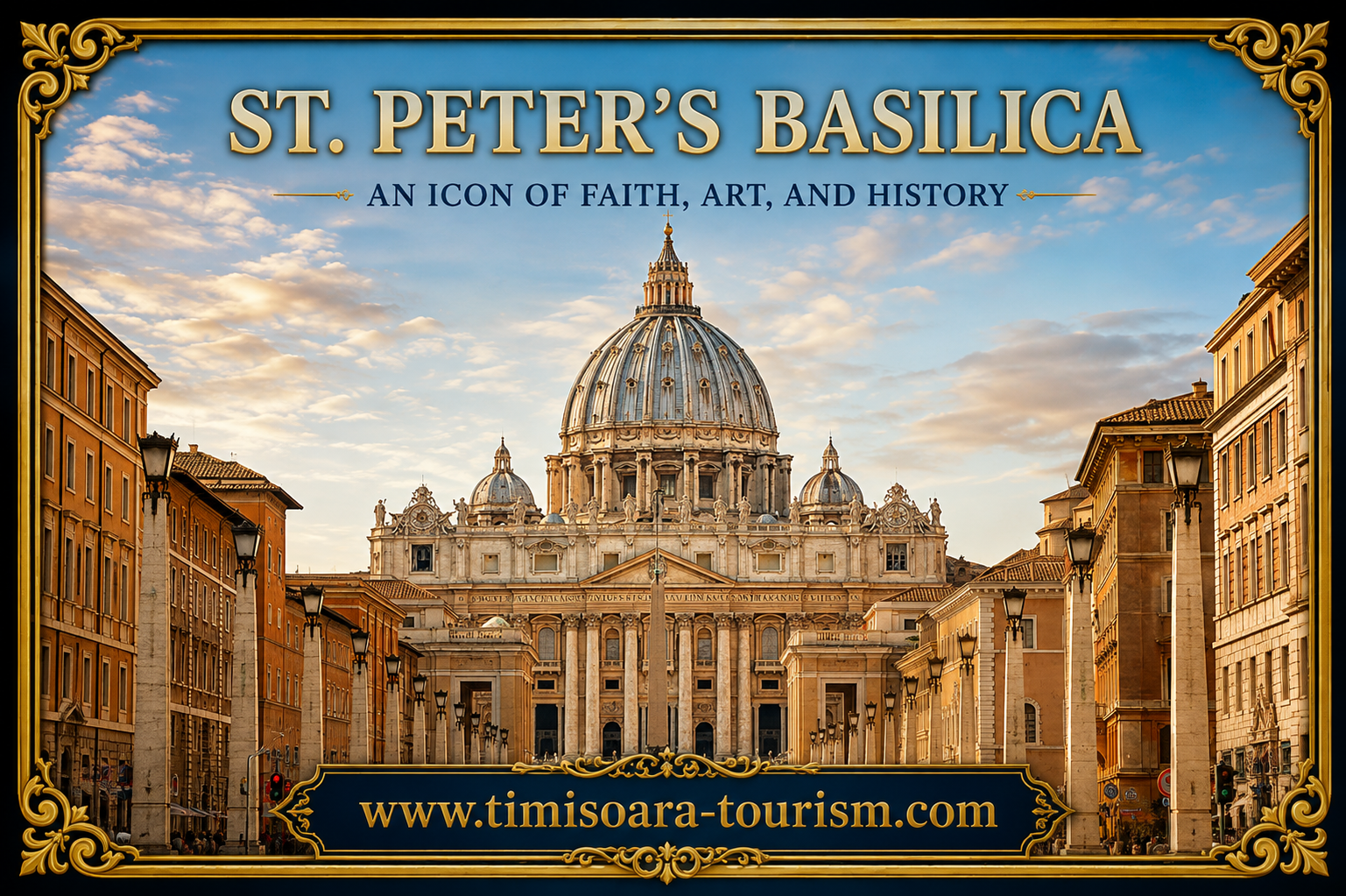
St. Peter’s Basilica stands beside the famous St. Peter’s Square in Vatican City.
Its official Italian name is Basilica Papale di San Pietro in Vaticano.
The basilica dominates the Vatican skyline with its enormous dome. Meanwhile, the vast square in front of the building creates one of the most recognizable views in Rome and Vatican City.
Visitors from around the world travel there for different reasons. Some arrive as pilgrims, while others come to explore its architecture, history, and priceless works of art.
An Older Basilica Once Stood on the Site
The current building was not the first St. Peter’s Basilica.
Emperor Constantine ordered the construction of an earlier basilica during the fourth century. That building stood for more than a thousand years.
However, its condition gradually deteriorated.
Construction of a new basilica began in 1506 under Pope Julius II. The enormous project continued for more than a century.
Pope Urban VIII finally consecrated the new basilica on November 18, 1626.
Therefore, the building visitors see today reflects generations of architectural development.
The Site Is Traditionally Linked to Saint Peter
The location has deep religious significance.
According to Catholic tradition, Saint Peter, one of Jesus Christ’s apostles, suffered martyrdom in Rome during the first century.
Tradition also holds that Peter was buried near the site where the basilica now stands.
This connection gave the location extraordinary importance to early Christians.
Later, the first basilica rose over the area associated with his burial place. The modern St. Peter’s Basilica continues that historical and religious connection.
Michelangelo Helped Design Its Famous Dome
The enormous dome is one of the most recognizable features of St. Peter’s Basilica.
Michelangelo became the chief architect of the project in 1546. He simplified earlier plans and played a major role in developing the dome’s design.
However, Michelangelo died in 1564 before workers completed it.
Giacomo della Porta and Domenico Fontana later continued the project. They completed the main structure of the dome near the end of the 16th century.
Today, the dome rises more than 130 meters above the basilica floor to the top of its cross.
As a result, visitors can spot it from many locations around Rome.
Michelangelo’s Pietà Is Inside the Basilica
St. Peter’s Basilica also houses one of Michelangelo’s greatest masterpieces.
The Pietà depicts the Virgin Mary holding the body of Jesus after the Crucifixion.
Michelangelo created the marble sculpture while he was still a young artist.
Its remarkable detail helped establish his reputation as one of the greatest sculptors of the Renaissance.
Today, protective glass surrounds the sculpture.
Nevertheless, visitors can still observe the extraordinary detail of the artwork from inside the basilica.
Bernini Created the Monumental Baldachin
Gian Lorenzo Bernini also left a major artistic mark on the basilica.
One of his most famous contributions is the monumental Baldacchino di San Pietro.
The huge bronze structure stands beneath the central dome and above the papal altar.
Four massive twisted columns support the baldachin.
Its dramatic design immediately attracts attention because of its scale and position. Moreover, the structure helps visually connect the altar with Michelangelo’s enormous dome above it.
Bernini Also Designed St. Peter’s Square
The architectural experience continues outside the basilica.
Bernini designed much of St. Peter’s Square during the 17th century.
Large curved colonnades surround the square. Hundreds of columns create a monumental entrance to the basilica.
The design is often interpreted as representing welcoming arms extending toward visitors.
An ancient Egyptian obelisk stands in the center.
The obelisk arrived in Rome during the Roman Empire. Pope Sixtus V later ordered workers to move it to its present position in 1586.
St. Peter’s Basilica Is Enormous
Size is another fascinating feature of St. Peter’s Basilica.
The building measures roughly 218 meters in length and covers an enormous interior area.
Its scale allows thousands of worshippers to gather during major ceremonies.
Interestingly, photographs often fail to communicate its true size.
Many sculptures, letters, and decorative elements appear relatively normal from the floor. However, several are much larger than visitors initially realize.
The vast interior creates this visual effect.
St. Peter’s Basilica Is Not the Pope’s Cathedral
One common misconception concerns the basilica’s official status.
Many people assume St. Peter’s Basilica is the cathedral of the Pope because it hosts many major papal ceremonies.
However, that is not the case.
The official cathedral of the Bishop of Rome is the Archbasilica of St. John Lateran.
Nevertheless, St. Peter’s Basilica remains one of the most important churches associated with the papacy.
Popes regularly celebrate major liturgies there. Furthermore, St. Peter’s Square often hosts enormous gatherings.
Several Popes Are Buried Beneath the Basilica
The complex also contains important burial areas.
The Vatican Grottoes sit beneath the main floor of the basilica. Several popes have been buried within this area.
Even deeper archaeological excavations revealed an ancient Roman necropolis.
Archaeologists conducted major excavations beneath St. Peter’s Basilica during the 20th century. These investigations uncovered ancient tombs and structures from Roman times.
The archaeological area remains particularly important because of its connection to the traditional burial place of Saint Peter.
The Basilica Combines Centuries of Art and History
St. Peter’s Basilica represents an extraordinary combination of religion, architecture, history, and art.
Several generations contributed to its development.
Michelangelo shaped its famous dome. Bernini transformed important areas inside the church and designed the monumental square outside.
Meanwhile, masterpieces such as the Pietà demonstrate the artistic achievements of the Renaissance.
The basilica also preserves connections to much earlier periods of Roman and Christian history.
For tourists, St. Peter’s Basilica offers an opportunity to explore one of Europe’s greatest architectural landmarks. For Catholic pilgrims, however, the site carries a much deeper spiritual significance.
These qualities have made St. Peter’s Basilica one of the most recognizable landmarks in Vatican City and one of the world’s most remarkable religious buildings.